

The Old Rules Are Dead: Your Competitive Advantages Are Evaporating Daily
How exponential change is inverting professional value hierarchies and making time the only currency that matters.


Your competitive advantages are evaporating at compound rates.
Whatever made you valuable six months ago is 50% less valuable today. Whatever skills differentiated you last year are becoming table stakes this quarter.
Quick math: You spent 168 hours last week. How many went to AI integration? If the answer is less than 15, you're falling behind at 3% per week. If it's less than 5, you're in free fall.
The professionals pulling ahead right now aren't smarter, younger, or more tech-savvy. They're allocating 30-45% of their time to AI-augmented workflows while everyone else optimizes processes that won't exist in 18 months.
The brutal reality: time allocation now predicts career trajectory better than experience, education, or industry expertise. And most professionals are allocating their time like it's still 2019.

The Expertise Trap
We've been telling ourselves a comfortable story about technological disruption: that wisdom matters more during uncertain times, that experience provides valuable pattern recognition, that deep expertise becomes a competitive moat when others are struggling to adapt.
The narrative seduces us with its comfort. Reality tells a different story.
When exponential change collides with accumulated expertise, knowledge transforms into a prison.
Consider the numbers. ChatGPT reached 100 million users in 2 months, a benchmark met faster than any technology in history. Instagram took 30 months to reach the same milestone. Netflix took 10 years. But user adoption is just the surface metric. The real disruption lies in capability acceleration.
GPT-4's improvement over GPT-3 happened in 18 months. GPT-4 to GPT-4o took 6 months. The next leap? Probably 3 months. Meanwhile, enterprise AI adoption jumped from 37% in 2023 to projected 86% by 2025.
Linear progress rewards experience as navigation. Exponential acceleration turns yesterday's best practices into tomorrow's bottlenecks.
Those fifteen years of campaign strategy still decode customer psychology beautifully. They cannot compete with AI-augmented speed. The senior developer's architectural expertise remains critical for system design, yet irrelevant when AI handles syntax, debugging, and pattern matching.
AI-native workflows can amplify experience into an advantage. Standing alone, experience becomes a competitive liability.
Everything that traditionally built professional authority now actively sabotages adaptation. Deep expertise makes you reluctant to admit when AI does something better. Institutional knowledge makes you defend processes that AI could improve. Hard-earned credentials make you resist tools that democratize your specialized skills. Years of experience make you skeptical of approaches that work but violate established patterns.
The professionals gaining unfair advantages right now treat their expertise as hypothesis rather than truth. They use AI to challenge their own assumptions, test their established methods, and experiment with approaches that contradict their experience. This requires intellectual humility: the confidence to know a lot combined with the wisdom to hold that knowledge lightly.
Authority in the AI era comes from demonstrating superior results, not superior knowledge.
This expertise trap explains why time allocation has become the only reliable predictor of professional success.
The Time Currency Revolution
When you stop fighting AI and learn to accept that time is your only non-renewable resource, everything changes.
AI can generate infinite content variations. It can process unlimited data sets. It can solve complex problems faster than human experts. But it cannot create more hours in your day.
When knowledge work becomes instantly accessible, time allocation becomes the ultimate competitive advantage. Not how much you know, but how quickly you can reconfigure what you know. Not your experience depth, but your adaptation velocity.
This creates a professional paradox: the more expertise you've accumulated, the harder it becomes to reallocate time toward new skill development. Deep knowledge creates cognitive anchors. Established workflows create efficiency habits. Institutional responsibilities create time commitments.
Those fifteen years of expertise did worse than lose value. They created barriers to learning the AI tools that could potentially 10x her output. The senior developer's architectural knowledge went beyond commoditization: it created resistance to AI-assisted coding practices that could double his productivity.
Meanwhile, professionals who treated their expertise as temporary, their workflows as experimental, and their time as the only non-renewable resource gained compounding advantages. This time scarcity becomes the foundation of every professional hierarchy shift we're witnessing.
The Proof: Everyone's on the Same Playing Field Now
AI's exponential trajectory is pulling everyone into the same competitive field regardless of age, background, or accumulated expertise. Consider three professionals facing the same AI-driven disruption:
Sarah, 28, Digital Marketing Specialist: Comfortable with new tools, native social media fluency, expects rapid change. Natural advantages? Tool adoption speed and comfort with ambiguity. Time allocation to AI integration: 30%.
Marcus, 42, Operations Director: Lived through multiple technology transitions, understands implementation challenges, knows organizational dynamics. Natural advantages? Change management experience and stakeholder navigation. Time allocation to AI integration: 15%.
Elena, 35, Product Manager: Bridge generation between digital natives and institutional veterans. Mixed background in startup environments and enterprise systems. Natural advantages? Translation between different operational contexts. Time allocation to AI integration: 45%.
Six months later, the results surprised everyone. Age, background, and starting advantages showed zero correlation with success. Time allocation predicted everything. Elena dominated. Not because of generational advantages or institutional knowledge, but because she allocated the most time to adaptation velocity.
This proves that traditional professional advantages have been neutralized. The playing field is level. Time allocation determines the winners.
The Value Inversion Pyramid
When knowledge becomes instantly accessible and problem-solving gets AI augmentation, only one skill remains difficult to replicate: the ability to reconfigure everything else quickly.
Traditional professional hierarchies ranked value predictably:
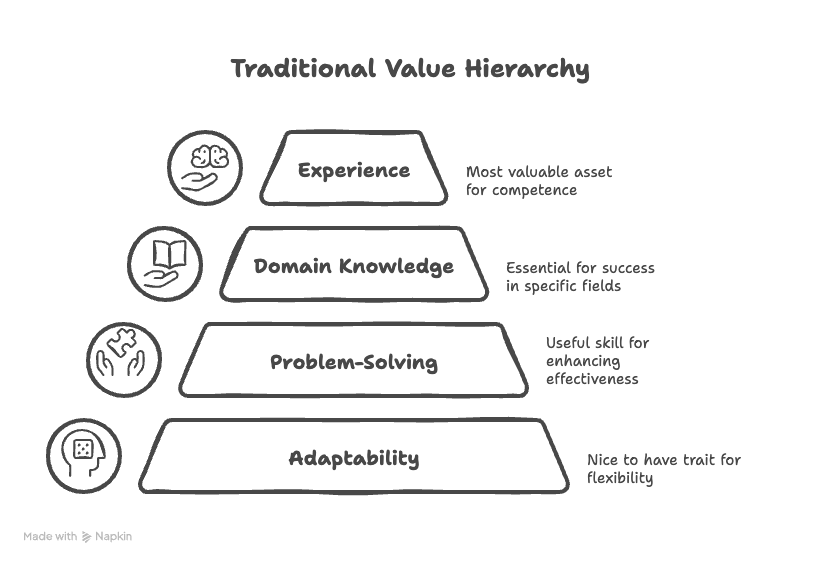
Experience formed the foundation. Domain knowledge built upon it. Problem-solving skills added value. Adaptability was bonus points.
AI inverts everything:
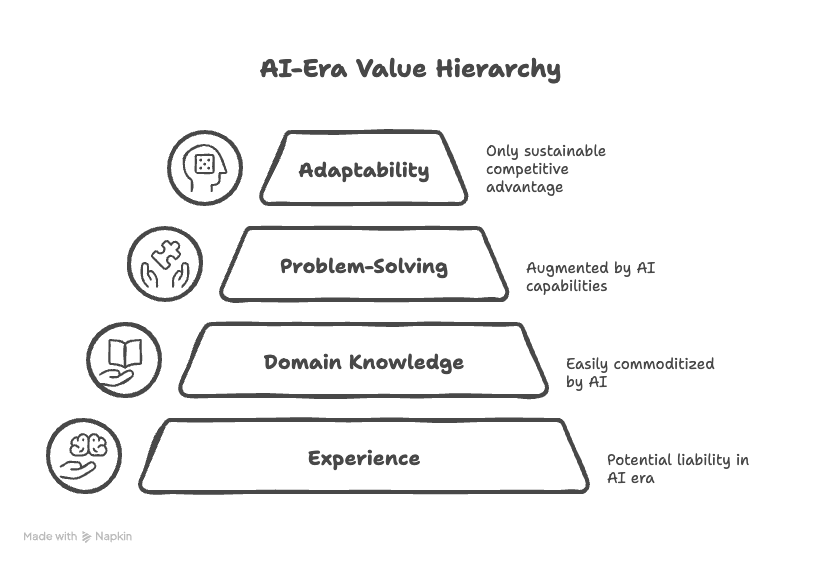
Evidence floods in daily. Software engineers complete tasks 50% faster with AI pair programming. Content creators compress blog posts from 8 hours to 30 minutes. Financial analysts build models in hours instead of days.
The pattern holds across industries: routine expertise gets commoditized while adaptation velocity becomes the differentiator. This inversion demands a systematic approach to rebuilding professional value.
The Speed Differential Strategy
Traditional career development emphasized depth: specialized expertise, industry credentials, institutional knowledge. On the other hand, the AI era is rewarding speed. Those who learn skills on the fly, turn in perfect deliverables in days instead of weeks, and pivot entire strategies when better approaches emerge are the ones reaping the rewards.
This isn't about abandoning domain knowledge; rather, it's about treating knowledge as renewable, not accumulated. Build the fastest pumps, not the deepest wells
The Time-First Professional Methodology:
Phase 1: Time Audit and Reallocation Map your current time allocation across four categories:
Value Creation: Direct output that advances business objectives
Knowledge Maintenance: Staying current in your field
Administrative Overhead: Meetings, reports, coordination
AI Integration: Learning and implementing productivity tools
Most professionals spend 60% on administrative overhead, 25% on knowledge maintenance, 10% on value creation, and 5% on AI integration. High-velocity professionals flip everything: 40% value creation, 30% AI integration, 20% administrative overhead, 10% knowledge maintenance.
Phase 2: Velocity Building Systems Rather than expertise accumulation, focus on adaptation acceleration:
Rapid skill acquisition: Use AI to compress learning curves in new domains
Tool integration cycles: Implement new productivity systems every 30 days
Competitive intelligence: Monitor what faster movers in your field are doing
Output measurement: Track productivity improvements, not knowledge accumulation
Phase 3: Speed Advantage Capture Use velocity differential to capture opportunities others miss:
Project leadership: Deliver results faster than traditional approaches
Strategic positioning: Become the go-to person for rapid implementation
Market timing: Enter emerging opportunities before they become crowded
Value demonstration: Show concrete productivity improvements, not just expertise claims
Age, industry, and starting experience level become irrelevant with this methodology. The marketing coordinator succeeded not through digital nativity but through time allocation to AI integration while others optimized existing workflows. The senior developer who adapted used experience to accelerate AI implementation rather than resist it. This systematic approach creates the foundation for capturing network effects that compound advantages exponentially.
The Network Effects of Early Adoption
Professional strategy operates ecologically, not just individually. Early adopters of time-first approaches create network effects that compound their advantages.
When you become known as someone who delivers results faster, you attract opportunities that require speed. When you become skilled at AI-augmented workflows, you get asked to lead AI implementation projects. When you demonstrate velocity building capabilities, you become valuable to organizations navigating exponential change.
These network effects accelerate quickly. The marketing coordinator didn't just gain individual productivity improvements; she became the go-to person for AI-assisted campaigns, which led to project leadership, which led to strategic involvement in company AI adoption. Her speed advantage created opportunities that experience alone couldn't access.
The compounding dynamics work across time horizons:
30 days: Productivity improvements in current role
90 days: Recognition as early adopter and implementation leader
6 months: Strategic involvement in organizational AI initiatives
12 months: Career advancement based on AI-era value creation
24 months: Industry recognition as thought leader in AI-augmented professional practices
But here's the crucial timing element: these advantages disappear as soon as AI adoption becomes mainstream.
The competitive edge exists only during the transition period when most professionals are still optimizing old workflows while a small percentage are building new ones
Understanding these network effects shapes how different professionals should approach the transition.
Applications Across Professional Contexts
Strategic Leaders: Stop being the answer person. Become the speed enabler. Your job isn't to have the best insights: it's to help your team generate insights faster than your competition can copy them.
Individual Contributors: Abandon expertise competitions. Win velocity competitions. While others perfect their craft, perfect your AI collaboration. The person who delivers excellent work in 2 hours beats the person who delivers perfect work in 2 days.
Career Pivoters: Skip the credential queue. Demonstrate value immediately using AI to compress 6-month learning curves into 6-week proof points. Traditional career advice says "prepare then transition." AI-era strategy says "transition while preparing."
Team Builders: Hire for adaptation speed over domain knowledge. The person who learns 3 new tools in 30 days is worth more than the person who knows 30 tools but hasn't learned a new one in 3 years.
The implications extend beyond individual strategy. Organizations, industries, and entire economic sectors are discovering that institutional knowledge provides less competitive protection than adaptation speed. Companies with decades of expertise are losing market share to startups with AI-augmented capabilities. Industries with regulatory moats are facing disruption from AI-native approaches that sidestep traditional barriers.
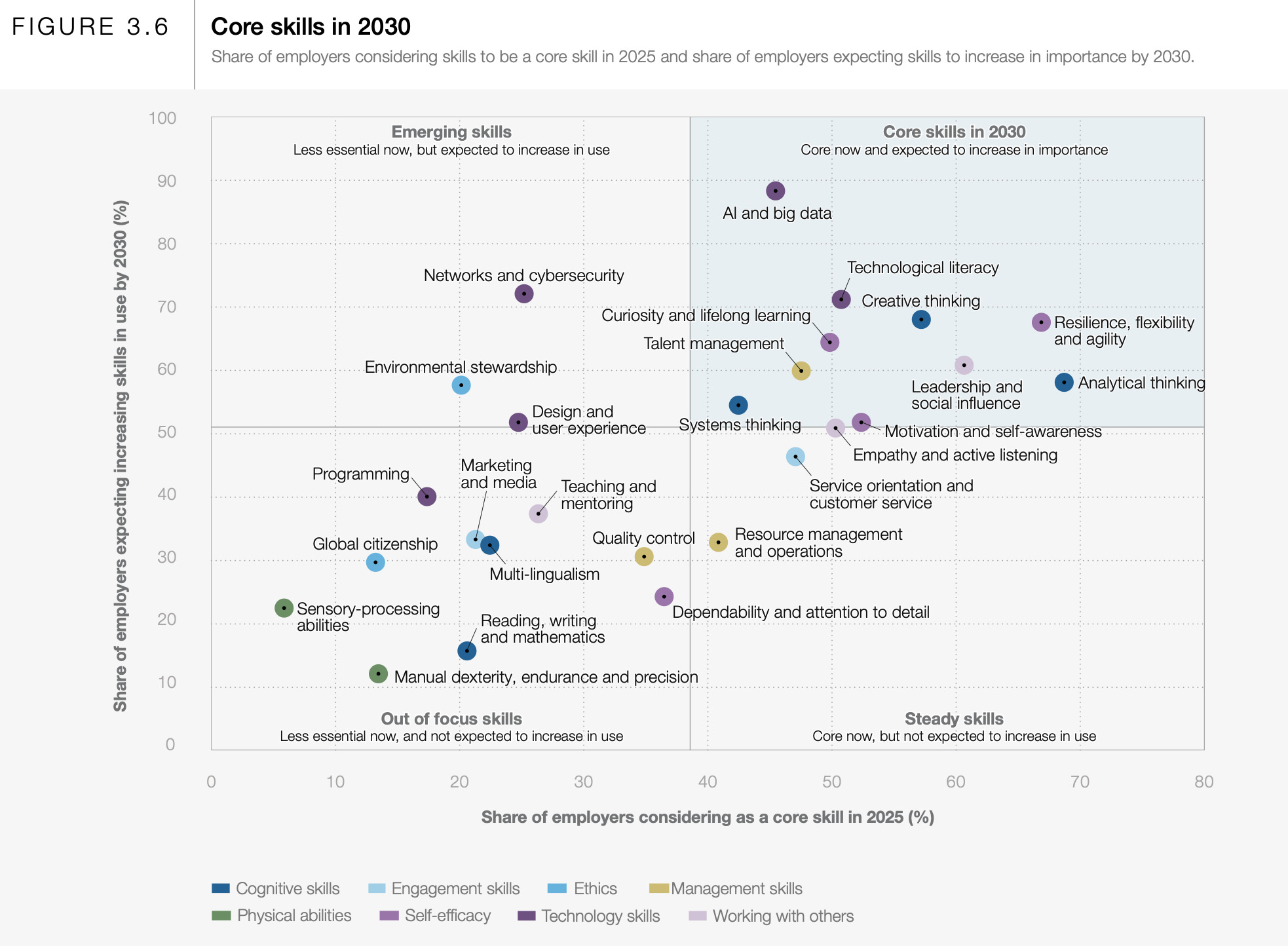
These applications become urgent when you consider the narrow window for competitive advantage and the stakes of missing it entirely.
The Competitive Window
The comfortable middle ground vanishes faster than most professionals realize, creating both unprecedented risks and opportunities.
The Stakes of Inaction
Traditional approaches and gradual AI adoption cannot coexist. The productivity gap between AI-augmented and non-AI-augmented work widens beyond incremental bridging. Organizations abandon slow adaptation when competitors move at AI velocity.
A professional split accelerates. High-velocity professionals treat AI as core infrastructure while traditional professionals treat it as optional enhancement. The gap between these groups widens exponentially rather than linearly.
Six months from now, that marketing coordinator's AI-augmented output will not be 2x more productive, they’ll be 10x. The senior developer's AI-assisted productivity will demonstrate order-of-magnitude differences, not incremental improvement.
Organizations will replace traditional approaches with AI-augmented approaches quickly and completely. They won't gradually transition their teams when facing this performance differential.
The professionals who survive this transition will be those who reallocated their time earliest and most completely toward adaptation velocity. Everyone else becomes a casualty of the great leveling, regardless of their expertise depth or experience breadth.
The Strategic Opportunities
This disruption creates specific advantages for ambitious professionals who act during the transition:
Contrarian Positioning: While others debate generational differences or argue about AI's limitations, position yourself as someone who understands value inversion and acts accordingly. This contrarian stance provides competitive advantages while mainstream adoption lags.
Authority Building: Establish yourself as an early expert in AI-augmented professional practices. Write about your experiments, share your productivity improvements, document your methodology. Authority in emerging domains grows exponentially during transition periods.
Network Development: Connect with other professionals who are taking time-first approaches to AI adoption. These networks become increasingly valuable as AI implementation accelerates across organizations.
Strategic Patience: Early adoption advantages help capture opportunities others miss, but these advantages remain temporary. Build sustainable capabilities rather than relying on early-mover benefits alone.
The professionals reading this analysis have a 6-12 month window to gain significant competitive advantages by understanding and acting on value inversion dynamics. After that window closes, these insights become common knowledge and the advantages disappear.
The Path Forward
AI transforms what we value about work itself. Experience, expertise, and institutional knowledge become table stakes rather than differentiators. Speed, adaptability, and velocity become the sustainable competitive advantages.
The gravitational force pulls everyone into the same competitive field regardless of background, age, or accumulated knowledge. Your existing advantages matter less than the speed of building new ones.
The marketing director and the senior developer both learned the same lesson: your expertise matters only if you can apply it at AI velocity. Your experience provides value only if you can combine it with AI capabilities. Your knowledge creates advantages only if you can use it to go faster, not just deeper.
AI can print infinite content, process unlimited data, solve complex problems at superhuman speed. It cannot print more time. How you allocate your time determines everything else.
The great leveling accelerates around us. The only question remaining: are you building advantages or defending obsolescence?
Start here: Audit your last 30 days. How much time went to knowledge maintenance versus velocity building? How much energy went to defending existing expertise versus developing AI-augmented capabilities?
Your time allocation patterns reveal which side of the great leveling you're on. More importantly, they reveal whether you understand that time has become the only currency that matters.
Leave a comment if you’ve experienced or felt any part of this shift in your workplace. This analysis represents a fundamental shift in how we think about professional development in the AI era. Next week, we'll explore the specific skills and systems that create sustainable competitive advantages when traditional expertise becomes commoditized.
This really resonates with me. Thanks for outlining this Zain!