

'Use AI More' Is Not a Goal
A formula for turning vague AI mandates into goals your manager can actually evaluate


Your 2026 goals are due soon. Maybe this week. Maybe next.
Somewhere in that form, you’re supposed to say something about AI.
“Use AI to improve efficiency.” “Leverage AI tools in my workflow.” “Incorporate AI into daily tasks.”
Stop.
Those aren’t goals. Those are wishes with a deadline attached.
And here’s the thing nobody told you: 91% of organizations are now using AI. But only 13% of employees have received any training on it.
Your company handed you a mandate without a playbook.
That’s not your fault. But it is your problem.
So let me give you what they didn’t: a formula that turns vague AI intentions into goals you can actually hit, even if your deadline is next week.
Why Most AI Goals Fail Before They Start
Before we fix your goal, let’s understand why the default approach doesn’t work.
I’ve watched this pattern play out across Fortune 500 teams: smart people submit vague AI goals, their managers approve them because they don’t know what “good” looks like either, and everyone spends the year in a fog of unmeasurable intentions. By Q4, nobody can say whether the goal was hit or missed—because nobody defined what “hit” meant in the first place.
Most AI goals fail because they fall into one of three traps:
1. The Vague Goal Trap
“Use AI more.”
More than what? For what tasks? How would you even know if you succeeded?
No measurement means no accountability. No accountability means no progress. You’ll check the box, do a few random ChatGPT searches, and end the year exactly where you started.
2. The Ambitious Goal Trap
“Become proficient in all major AI tools by end of year.”
This sounds impressive. It’s also impossible to execute.
Too big. No starting point. Guaranteed overwhelm.
Here’s the reality: only 35% of business leaders feel prepared for AI-driven transformation. The goal isn't to master everything. It's to get competent at one thing that actually matters to your work.
3. The Wrong Metric Trap
“Spend 3 hours per week using AI tools.”
This measures activity, not outcomes. You could spend three hours getting mediocre results and technically hit your goal.
The question isn’t how much time you spend with AI. It’s what you produce with that time.
The Root Problem
You’re not bad at setting goals. You’re just missing the formula.
75% of employees are adopting AI tools, but only 35% have received any training. Your company told you to set AI goals but never showed you what a good one looks like.
Let me fix that.
The SMART Framework, Adapted for AI
You know SMART goals: Specific, Measurable, Achievable, Relevant, Time-bound.
Here’s how each element actually applies to AI:
Specific: Not “use AI” but “use AI to [specific task]”
Bad: “Use AI in my workflow” Good: “Use AI to draft first versions of my weekly status reports”
Name the task. Name the output. If you know the tool, name that too. The more specific, the more actionable.
Measurable: Count outputs, not hours
Bad: “Spend 2 hours per week with AI” Good: “Produce 4 AI-assisted first drafts per month”
The shift: from activity to output. Hours spent means nothing. Work produced means everything.
Achievable: Start with ONE use case
The biggest mistake people make with AI goals? Trying to transform everything at once.
Pick one workflow. Get competent at it. Then expand.
Your goal should stretch you slightly—not paralyze you. If you read your goal and feel mild discomfort, you’re in the right zone. If you feel dread, scale back.
Relevant: Pick something you do FREQUENTLY
AI saves the most time on repetitive tasks. If you do something once a quarter, don’t start there.
Weekly tasks. Daily tasks. That’s where the ROI lives.
Ask yourself: What do I do repeatedly that takes too long? Start there.
Time-bound: “By end of Q1” with a checkpoint
Quarterly goals need quarterly deadlines. But build in a checkpoint—Week 4 is a good place to gut-check whether you’re on track or need to adjust.
The Goal Formula
Here’s the formula. Memorize it.
“By [date], I will use AI to [specific action] for [specific deliverable/task] [frequency], resulting in [measurable outcome].”
![Infographic showing the AI goal formula template: "By [date], I will use AI to [specific action] for [specific deliverable/task] [frequency], resulting in [measurable outcome]." Each component is color-coded in brand blue, teal, and amber gold.](https://substackcdn.com/image/fetch/$s_!2tW9!,f_auto,q_auto:good,fl_progressive:steep/https%3A%2F%2Fsubstack-post-media.s3.amazonaws.com%2Fpublic%2Fimages%2Fd1eec6ad-a58c-448e-97c7-a7503ece6c94_2752x1536.png "Infographic showing the AI goal formula template: \"By [date], I will use AI to [specific action] for [specific deliverable/task] [frequency], resulting in [measurable outcome].\" Each component is color-coded in brand blue, teal, and amber gold.")
Let me show you what this looks like in practice:
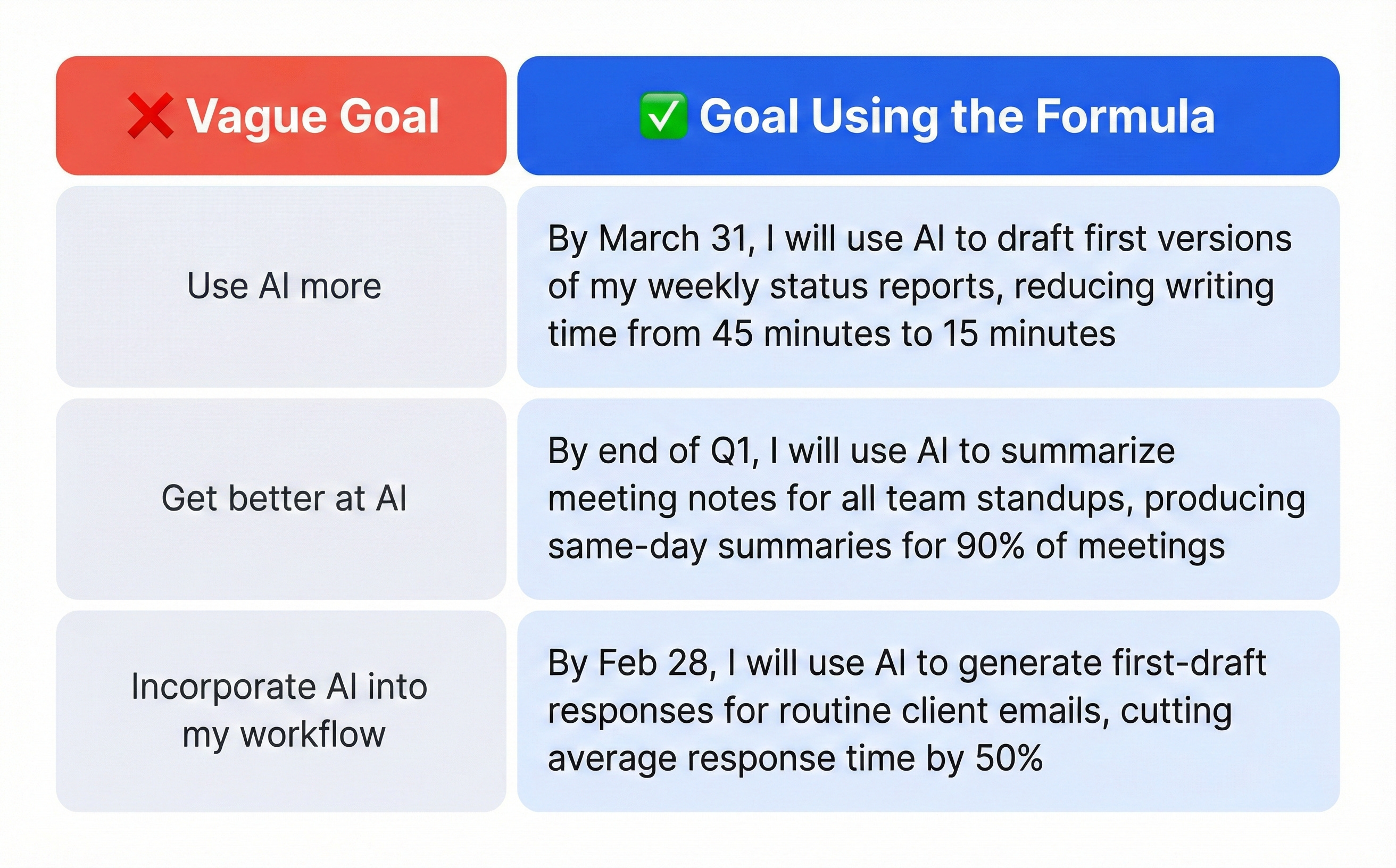
See the difference?
Vague → Specific task
Activity → Output
Someday → By [date]
Feeling → Measurement
Your manager can evaluate “same-day summaries for 90% of meetings.” They cannot evaluate “get better at AI.”
Build Your Goal: Three Ways
You’ve got the formula. Now let’s put it to work.
Pick your path based on how much time you have:
Option 1: Steal a Goal (2 minutes)
I’ve compiled 100+ ready-to-use AI goals across 26 roles—Analyst, Manager, Sales, Marketing, PM, HR, Finance, Engineer, Designer, Legal, and more. Find yours, tweak the dates and metrics, submit.
Best for: You just need something solid to submit. Fast.
Option 2: Use the Prompt (5 minutes)
👇 Copy this prompt and paste it into ChatGPT, Claude, or Gemini:
You are an AI goal-setting coach who specializes in turning vague intentions into specific, achievable goals. I have an AI-related goal that I need to sharpen before I submit it.

My current goal (probably vague): [Paste your goal, e.g., "Use AI more in my work"]

My role: [Your job title and main responsibilities]

One task I do frequently that takes too long: [Something you do weekly or daily]

Now help me transform this into a SHARP goal:

1. **Call out the vagueness** — What specifically is unclear or unmeasurable about my current goal?

2. **Identify the REAL outcome I want** — Based on my role, what would success actually look like?

3. **Rewrite my goal using this format:**
   "By [specific date], I will use AI to [specific action] for [specific deliverable/task] [frequency], resulting in [measurable outcome]."

4. **Give me the "Week 1 Action"** — The single specific thing I should do in my first week.

5. **Predict my failure point** — Where am I most likely to abandon this goal, and how do I prevent it?

Be direct. My deadline is coming.
Paste that into your AI tool, fill in the brackets, and you’ll have a submittable goal in five minutes. Best for: You have a rough goal in mind and want AI to sharpen it.
Option 3: The Full Toolkit (10 minutes) ⭐ RECOMMENDED
The prompt above sharpens ONE goal. The toolkit does everything:
Generate goal ideas based on YOUR specific role and tasks
Adjust for your company’s approved AI tools
Build a 30-day skill-building plan
Format everything for your company’s goal system
Give you talking points for your manager conversation
It’s an interactive workflow that asks the right questions and builds your complete AI goal package, not just the goal itself, but the plan to actually hit it.
(The toolkit runs on Claude, Anthropic’s AI assistant. You’ll need a free Claude account to use it, if you don’t have one yet, you can sign up here in about 30 seconds.)
Best for: You want to do this right, not just check a box.
What Nobody’s Telling You
Here’s the part most productivity content won’t say out loud:
Your company SHOULD have given you vague AI goals.
I know that sounds backwards. But hear me out.
If your company had given you specific AI goals—”Use Claude to draft status reports every Tuesday”—those goals would be specific to someone else’s workflow. Someone in a different role, with different tasks, different tools, different constraints. Specific goals handed down from above are just a different kind of wrong.
The uncomfortable truth is that nobody can tell you your best AI use cases. Not your manager. Not HR. Not the consultants your company hired. The only person who knows what you do repeatedly, what takes too long, and where AI could actually help… is you.
Vague goals are the default because nobody knows what “good” looks like.
Your company didn’t give you examples because they don’t have them. HR didn’t provide a template because no one’s written one yet. The consultants gave leadership a strategy deck, but nobody translated that into “here’s what this means for an individual contributor filling out a goal form.”
You’re not behind. Everyone is figuring this out in real time.
Specific goals force you to actually learn.
This is the hidden gift of the exercise. Vague goals let you coast. “Use AI more” can mean anything, which means it usually means nothing.
But when you write “By March 31, I will use AI to draft first versions of my weekly status reports, reducing writing time from 45 minutes to 15 minutes,” now you have to actually figure out how to do that. You have to pick a tool. Learn a workflow. Build a habit.
The goal itself becomes the training program. That’s not a bug. That’s the feature.
Your goal should scare you a little.
If your AI goal feels completely comfortable, you’re not growing. The right goal sits in the zone of “I don’t know exactly how to do this yet, but I can figure it out in a quarter.”
Here’s the context that makes this real: IDC estimates a $5.5 trillion skills gap in AI workforce readiness. You’re not imagining the pressure. It’s real. And the people who turn vague mandates into specific skills will have options that others won’t.
But pressure without direction is just stress. Now you have direction.
Speaking of direction, I started a community called Beware The Defaults for people who are actually doing this work, not just reading about it. Daily practice, real accountability, and a group that’s figuring out AI together. There’s a 7-day free trial if you want to see what it’s like inside.
What to Do Right Now
Use the formula
Pick ONE workflow
Make it measurable
Submit with confidence
Your deadline is coming. But here’s what I want you to remember: the fact that you’re reading this—that you searched for help, that you’re trying to do this right—already puts you ahead of most people who will submit vague goals and hope for the best.
You’re not behind. You’re just getting specific.
And specific is how you actually get better at this.
Coming next: How to find your best AI use cases (because nobody can tell you; you have to discover them yourself).
What AI goal are you setting for 2026? Drop it in the comments, I read every one.
Love SMART framework and the prompt you shared to make the goal actionable. Thanks for putting this together, Zain!
Yeah, vague goals don't get hit. Vague AI usage is just a waste of resources.