

Field Notes #003: Entry-Level Jobs Now Want Senior Skills
A Weekly Field Guide for Professionals Navigating the AI Transition

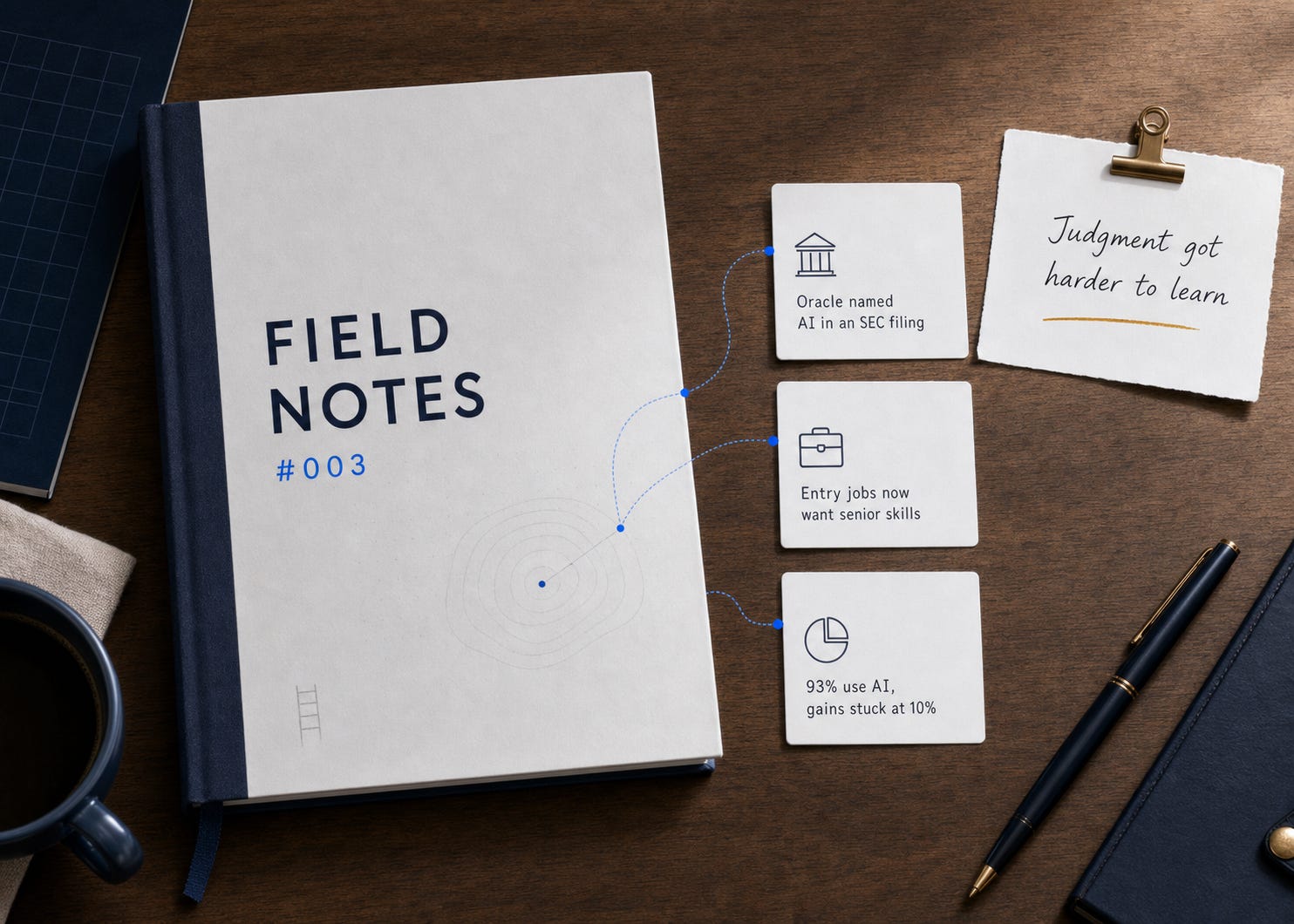
A month ago it was a prediction. This week it was a filing.
For two years the AI jobs conversation ran on predictions. Bold ones. A month ago the people who made the boldest started taking them back: Sam Altman said he’d been “pretty wrong” about the economic fallout, and Dario Amodei softened his old line that AI would erase half of entry-level white-collar work. Then, this week, while the forecasts were busy retreating, Oracle quietly did something none of the predictions did. It wrote AI into a federal filing as a reason 21,000 of its people no longer have jobs.
So the story changed registers. It went from what might happen to what’s on the record. And once you read the week as a record instead of a forecast, a sharper pattern shows up underneath the layoff headline.
The format is simple.
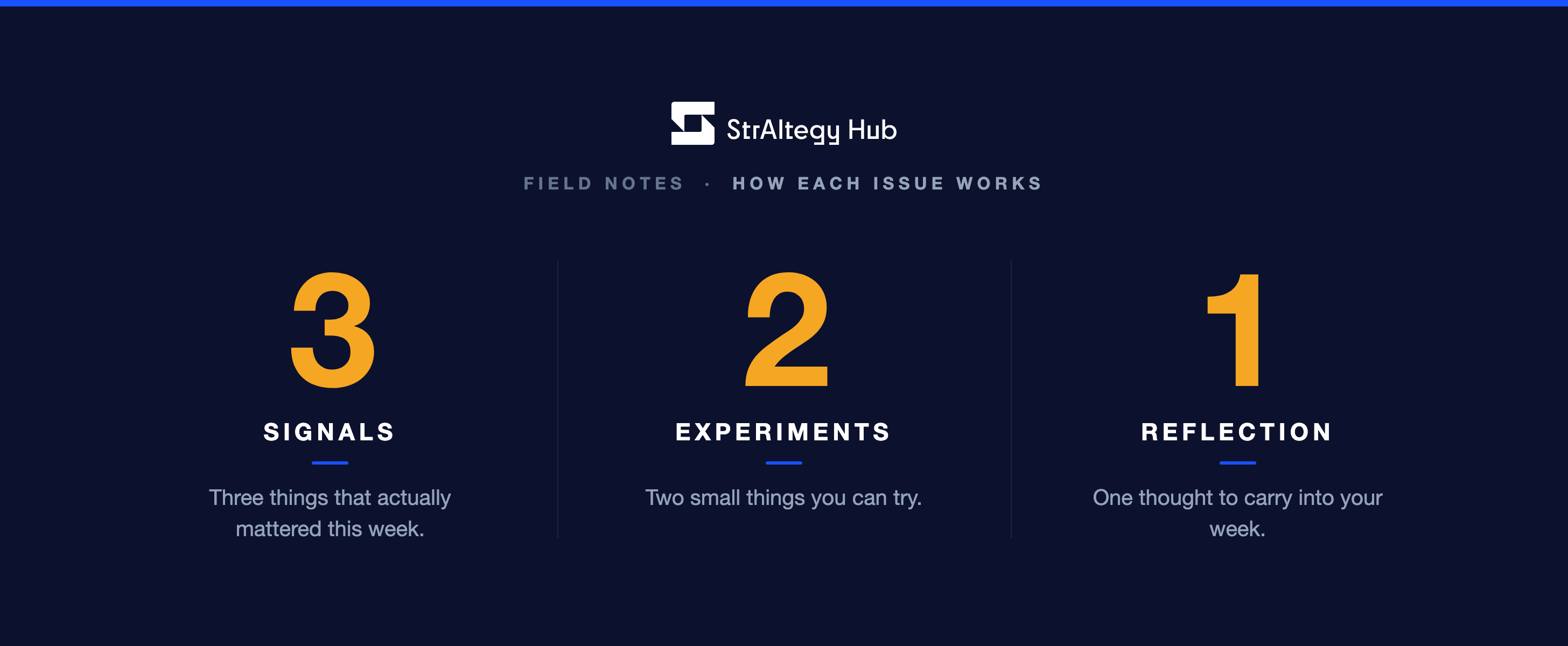
It’s not a news roundup, and it’s not a list of tools. Plenty of people will tell you what happened. The job here is to tell you what it means. This week it meant one thing, said three ways: the skill everyone now needs is getting harder to build.
The Week
Last issue the lesson was that the advantage moved up the stack, to the people who could govern an agent, give it clean context, and judge what it produced. Call that one skill by its real name: judgment. The ability to tell a good answer from a plausible one.
This week the field handed us the receipts on judgment, and they don’t agree with each other. One set says judgment is now the whole game. A company put it in an SEC filing. Hiring data shows employers demanding it at the entry level, where it never used to live. The productivity numbers show it’s the real bottleneck behind every AI tool.
The other set is quieter and more unsettling. The same forces pricing judgment up are removing the ordinary work people used to climb through to build it. The first drafts, the grunt research, the simple tickets, the junior reps. AI is eating exactly the rungs you used to step on.
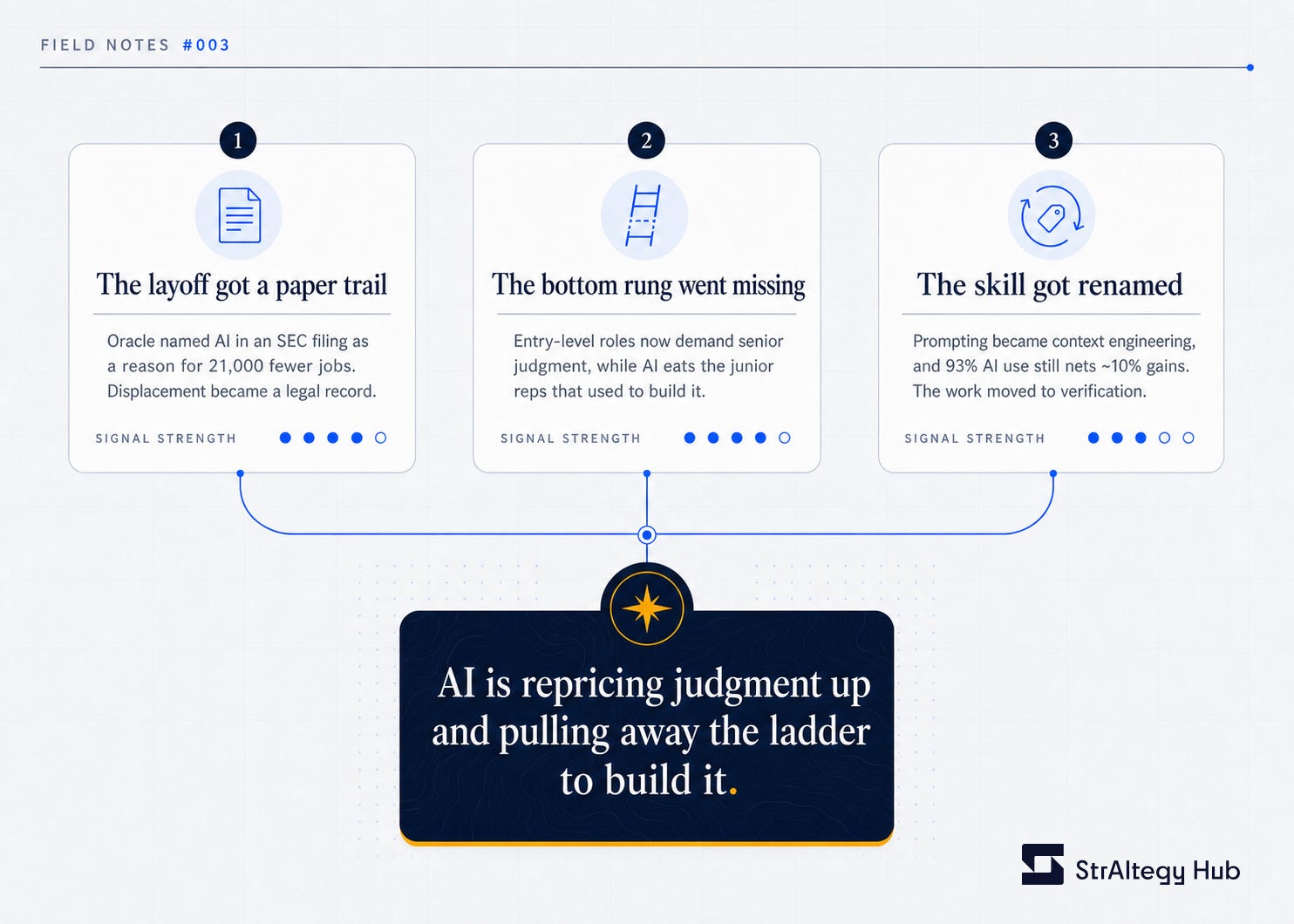
So here’s the week in one line: AI is making good judgment more valuable and harder to earn at the same time. Here’s what that looked like.
3 Signals
Signal 1: The layoff got a paper trail
What happened
This week Oracle disclosed that its headcount fell by about 21,000 people over the past year, from roughly 162,000 to 141,000. That alone is a big number. What made it a milestone is where it showed up and how it was worded. In its annual SEC filing, the legal document a public company swears is accurate, Oracle wrote that “the adoption and deployment of AI technologies across our operations have resulted, and may continue to result, in reductions to our workforce.” (An SEC filing is the audited report companies are legally required to give investors. It’s the opposite of a press release. You don’t put a line in it lightly.)
That’s the first time a major company has named AI as a cause of layoffs in a federal filing, rather than in an interview or a memo. And the timing is the tell. Just a month earlier, the loudest voices were walking their forecasts back. Altman admitted he’d been “pretty wrong” on the social and economic side. Amodei, who’d said AI could wipe out half of entry-level white-collar jobs and push unemployment toward 20%, shifted to saying automation might expand the work people do. The Yale Budget Lab, tracking the labor market since ChatGPT shipped, still finds no broad unemployment spike for AI-exposed workers.
What this reveals
Watch the misdirection. Predictions are cheap and reversible. You can say AI will take half the jobs, get headlines, and quietly take it back when the IPO paperwork is due. A filing is different. A filing is a paper trail.
But read Oracle’s own numbers and the headline gets more complicated. The same filing shows capital spending jumped 162% to $55.7 billion, almost all of it pouring into AI data centers. The cuts aren’t only “the robot did your job.” They’re also a company moving cash from payroll to compute, and using AI as the cover story that makes it sound inevitable instead of chosen. That matters, because “AI did it” is becoming the most convenient sentence in corporate America, and it ends arguments it shouldn’t end.
So the 21,000 is real, and it’s worth your attention. But it’s also the loud number, the one designed to be looked at. The number that actually decides your future this week is quieter, and it’s hiding one signal down.
Sources: Oracle sheds 21,000 roles amid AI layoffs (CNBC, June 23, 2026) · Altman and Amodei walk back the jobs apocalypse (Fortune, May 26, 2026)
Signal 2: The bottom rung went missing
What happened
Here’s the quiet number. PwC’s 2026 Global AI Jobs Barometer read more than a billion job ads across 27 countries and found something strange happening at the bottom of the ladder. Entry-level roles in the jobs most exposed to AI are now seven times more likely to demand skills that used to show up much later in a career: judgment, strategic decisions, stakeholder management, the senior stuff. In the most exposed work, 52% of the new skills appearing in entry-level postings were ones we used to associate with experienced people. Fortune gave it a name: seniorization.
The shape gets clearer when you look at the openings themselves. Entry-level roles that demand these senior skills have grown 35% since 2019. Ordinary entry-level roles, the kind a new grad could actually start in, shrank 10%. So the door didn’t close. It just moved up a floor, and took the staircase with it.
What this reveals
This is the signal under the signal. AI is very good at exactly the work the bottom rung was made of: the first draft, the background research, the simple ticket, the rote analysis. That work was never valuable for its output. It was valuable because it was how a person built judgment, one unglamorous rep at a time. You learned to spot the wrong answer by producing a few hundred of them yourself.
Now employers want the judgment without funding the apprenticeship that produced it. They want people who can supervise AI’s work on day one, in roles that used to exist precisely so you could learn by doing the work AI now does. Last issue’s reflection asked whether you could tell when an agent got your job wrong. This is the harder version of that question, pointed at the whole pipeline: you cannot supervise what you were never allowed to learn. The scarce skill and the broken path to it are the same story.
Sources: PwC 2026 Global AI Jobs Barometer (PwC, June 2026) · Entry-level work didn’t disappear, it “seniorized” (Fortune, June 18, 2026)
Signal 3: The skill got renamed, and the productivity story got honest
What happened
If judgment is the scarce thing, the week also told us what it’s being renamed to. For two years the hot skill was “prompt engineering,” writing the clever instruction. That’s now being demoted to one small input. The skill people are actually hiring for is “context engineering”: designing everything the model sees before it answers, the data, the memory, the examples, the brief. Andrej Karpathy named it in 2025, and it’s spread from engineering teams into job postings and interviews. The shift is subtle but it’s the whole game. The question moved from “what do I tell the model to say” to “what does the model need to know, and is what it gave me back actually right.”
And the honest productivity picture finally caught up. About 93% of developers now use AI coding tools, yet measured productivity gains are stuck around 10%, and AI already writes roughly 27% of production code. A landmark trial from METR put the paradox in sharp relief: experienced developers were 19% slower on real tasks with AI, while feeling about 20% faster. Only around 29% say they trust what the AI hands them.
What this reveals
Sit with the gap between feeling faster and being slower, because it explains the whole week. The work didn’t disappear when AI got good. It moved. It moved from producing the thing to checking the thing, from writing to verifying, from “can I make this” to “can I tell if this is wrong.” Call it the verification tax. Everyone’s paying it, and most people can’t feel themselves paying it, which is why raw AI usage doesn’t turn into output.
This is why “context engineering” is more than a new job title. Feeding the model good context and judging what comes back are the same muscle: knowing your domain well enough to set it up right and catch it when it drifts. That muscle is judgment again, wearing a technical hat. The model got cheap and confident. The scarce, expensive, slow-to-build thing is the human who can tell when its confidence is misplaced. The tools keep getting smarter. The bottleneck is, and stays, the quality of the person holding them.
Sources: Context engineering, the skill replacing prompt engineering (Karpathy, 2025) · Measuring the impact of AI on experienced developer productivity (METR, July 2025) · 93% of developers use AI, productivity still ~10% (ShiftMag, 2026)
2 Experiments
Experiment 1: Run a one-week verification log
Try this
For the next week, every time you use something AI made you, a draft, an analysis, a chunk of code, an email, spend thirty seconds before you send it writing down the one change you had to make and why. Just a running list in a note. What did you catch. What did you fix. What did you wave through unread. By Friday you’ll have something most people never see: a map of your own judgment.
Why it matters
The verification tax is invisible until you measure it, the same way those developers couldn’t feel themselves slowing down. The log makes it visible. The places you reliably catch errors are your moat, the senior judgment this whole wave is repricing. The places you rubber-stamp without checking are your exposure. You can’t get better at telling true from plausible if you never notice yourself doing it. Fifteen minutes of noticing this week buys you a clearer picture of where your real value sits than any think piece on the future of work.
Experiment 2: Rebuild one rung
Try this
Pick one task AI now does for you that you couldn’t fully evaluate if you had to, the thing you accept because checking it feels too hard. Do it by hand, once, this week. Not to be slow on purpose, but to feel where your own judgment has gone thin. Then, if you manage people, do the inverse: hand a junior one “AI could do this” task on purpose, as reps, and protect the time it takes.
Why it matters
This is how you fight the missing rung on both ends. Doing the task yourself rebuilds the apprenticeship AI quietly removed from your own week, the rep that teaches you to spot a wrong answer before you can explain how you knew. And handing a junior real reps is the thing almost no company is doing right now, which means doing it is a quiet advantage. The skills that compound are the ones you keep practicing. AI just made it tempting to stop practicing the most important one.
1 Reflection
The loud story this week was a number, 21,000, designed to be stared at. The quiet story is the one worth carrying. AI is making good judgment the most valuable thing you own, and at the very same time it’s absorbing the ordinary work that used to build it. The price went up and the path got narrower in the same week.
So here’s the thing worth carrying into your week:
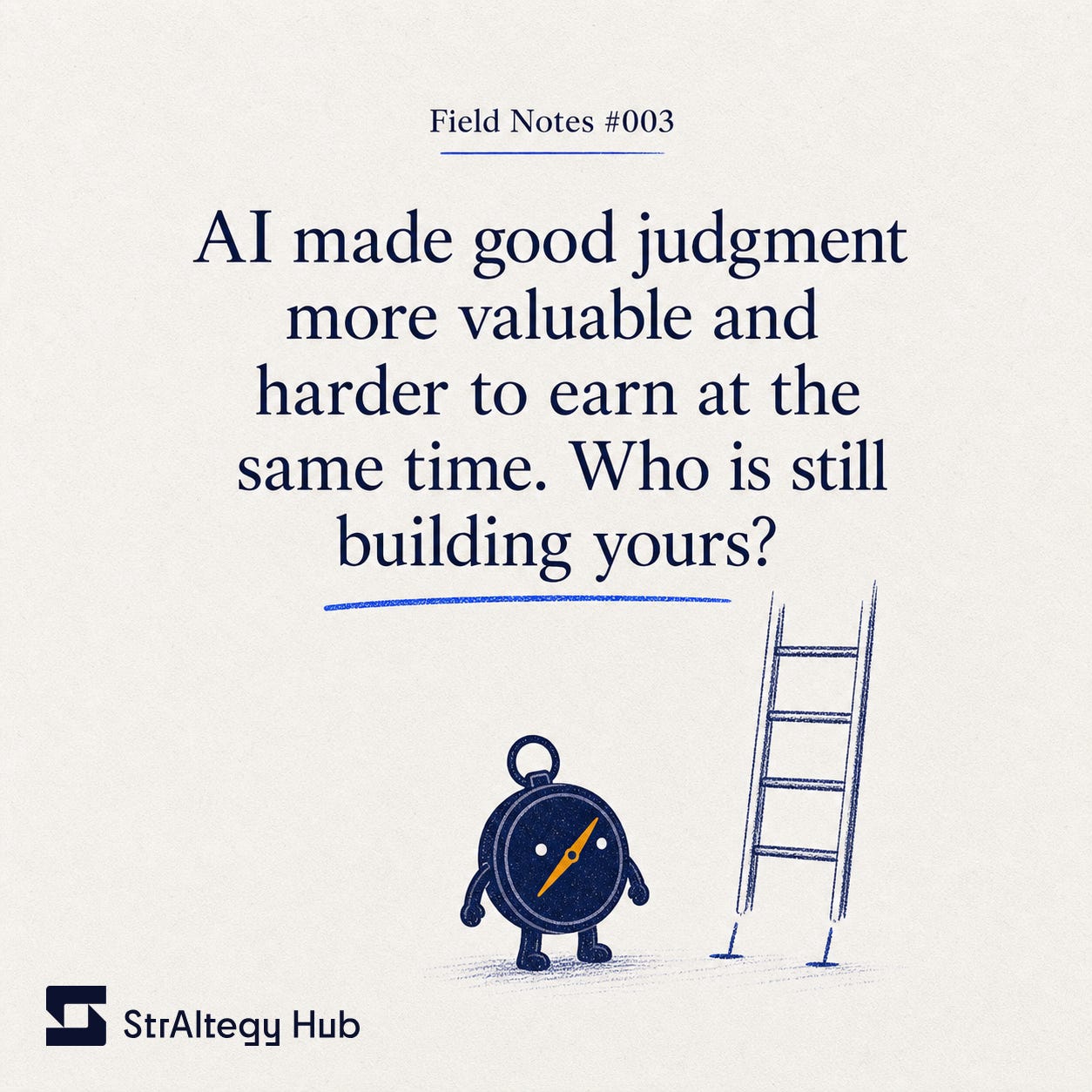
The scarce skill is no longer doing the work. It’s knowing when the work is wrong. So who is still building that in you, and what happens if the answer is only you?
That answer is your edge, and unlike the model, nobody can switch it off. Go build more of it.
That’s Field Notes #003. If it helped you see the week a little clearer, forward it to one person trying to do the same. I’ll be back when the field hands me the next one worth your time.
Every company now seems to want a 24-year-old with AI fluency, senior judgment and the calm eyes of someone who’s survived three procurement cycles.
Lovely job spec. Small issue: nobody wants to pay for the years that create that person.
Zain, The paradox of AI usage shows a gap between perceived and actual productivity gains.
Understanding the verification tax is crucial for navigating the evolving job landscape effectively. How can professionals adapt to these new expectations and develop the necessary judgment skills?